The Real Value of AI in Eye Care Is Time Back for Patient Care
Key Takeaways
- AI is most useful when it reduces routine work that competes for staff attention.
- The goal is not more information, but less time spent managing it.
- Successful adoption starts with showing staff what will change in their day.
- A useful measure of AI is what doctors and staff can spend more time doing.
Routine office work adds up quickly in an eye care practice. Each task looks small, but together they pull attention away from patients all day long.
This is where AI can make a practical difference. Beyond how much data it can process, the question that matters is simple. Can the technology take on routine work so doctors and staff have more time for the things that need their judgment?
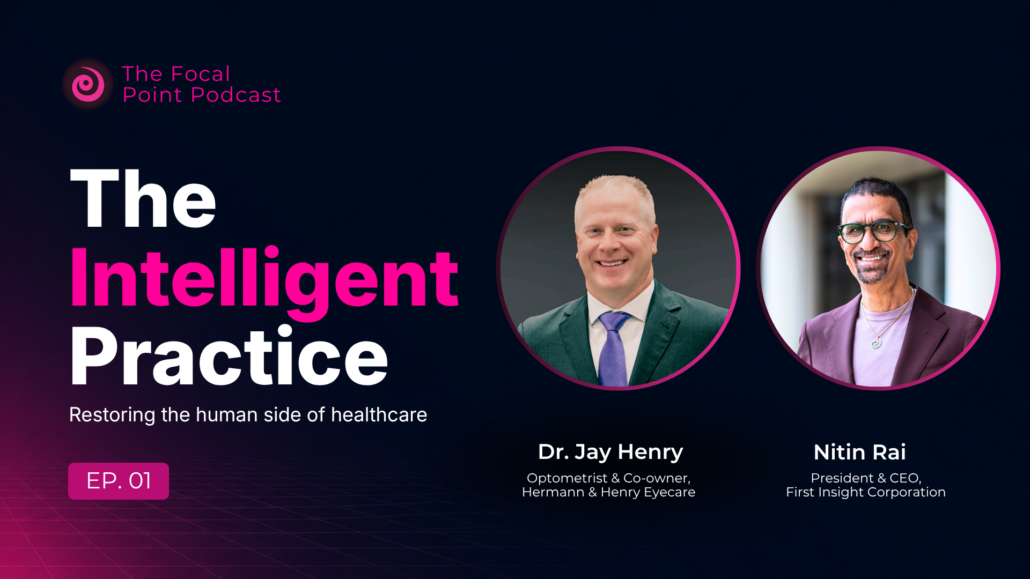
In the first episode of The Focal Point, “The Intelligent Practice: Restoring the Human Side of Healthcare,” Nitin Rai, President and CEO of First Insight and EVAA.AI, and Dr. Jay Henry, optometrist and co-owner of Hermann and Henry Eyecare, discuss what that shift looks like inside a working practice.
Their discussion brings the value of AI back to a practical question: Where could your team spend more time if routine work required less of it?
More Information Is Not the Same as Better Care
Dr. Henry describes AI as a “second set of eyes,” not the only set. It can review patient history, bring something forward that deserves attention and help the clinician get to relevant information sooner. He adds, “the biggest opportunity I see in my office with AI is handling the follow-through.”
The goal is not to give clinicians another dashboard to review. It is to make relevant information easier to use while protecting time for the patient in front of them. AI becomes useful not by adding more information to manage, but by helping clinicians spend less time managing it.
Technology Should Give Doctors More Time With Patients
A tool cannot be judged only by what it adds to the system. More information does not always lead to better patient care.
For Nitin Rai, the problem became clear during his own glaucoma appointment.
“I went for my glaucoma checkup with a very well-respected glaucoma specialist at Bascom Palmer Eye Center, and he spent 20 minutes with his back to me, typing away while he’s having a conversation with me.”
Rai describes that experience as a trigger for his work with EVAA. The issue was not the doctor’s expertise. He was seeing a highly respected glaucoma specialist. The issue was how much of the visit the technology demanded.
Dr. Henry describes what patients want in simpler terms: “They want our time. They want face to face. They don’t want our back. They don’t want us typing all the time.”
That sets a practical standard for AI in eye care: technology should give doctors more time looking at the patient, not more time looking at a screen.
Much of AI’s Practical Value Happens Outside the Exam Room
Dr. Henry points out that the exam room “is only a small part of where AI makes a difference.” What determines whether a patient gets good care happens around it: “It’s the scheduling. It’s the insurance verification. It’s your recall system. It’s how your charts get prepped. It’s how a finding gets flagged.”
Each of these tasks takes only a few minutes but those minutes repeat across every patient and every day. A five-minute task repeated across 30 patients becomes two and a half hours of staff time. Dr. Henry’s practice launched the EVAA Virtual Assistant about a year and a half ago. On the first day, 15 to 20 patients booked exams through it, and call volume dropped enough that his staff noticed immediately. “We aren’t having to spend all day just chasing the phones,” he says. “We’re actually having time to have conversations with the patients when they check in and when they check out.” From there the practice kept going: insurance benefits, prior authorizations, claims creation and submission, payment posting. Repetitive data work happens in the background, giving staff more time for the work that actually needs them.
That Should Also Change What We Expect From the EHR
For years, healthcare software has depended on people to operate it. Staff enter information, move between screens, find what they need and ensure the next step.
Rai argues that the system should take on a more active role. It should be able to summarize useful information, support documentation, coordinate workflow steps and help move information where it needs to go.
The point is not to make the EHR more sophisticated for its own sake. It is to reduce the time people spend managing the software.
If staff still have to move between disconnected systems, enter the same information twice or continually check whether work has been completed, adding AI may simply shift the workload. This means that practices evaluating new technology need to look beyond individual features. Documentation, patient communication, insurance and billing should work in ways that reduce manual handoffs rather than creating new ones.
The closer technology gets to handling routine work in the background, the less attention staff have to spend operating it.
Staff Need to See What Changes for Them
Dr. Henry described early skepticism among his staff, including concerns about whether AI would eventually replace their jobs. Some of that was his own doing. Early on, he made the mistake of announcing a new tool the day before it launched and expecting the team to adapt. “It’s not really a technology problem,” he says. “It’s a trusted workflow problem.” Picking the right tool and calculating the ROI turned out to be the easy part. The hard part was getting the team to trust a different way of working. That changed once they saw it handling repetitive tasks they did not enjoy while giving them more time for patients.
As he explained, once the team experienced the difference, “they started saying, ‘What else can this technology do for us?’”
The lesson for practice leaders is simple: start with the work, not the software. Show staff what AI will take off their plate, where their experience still matters and how the time saved can make their day easier.
Time Back Changes the Day
The result is a practice where technology fades into the background and people have more time to be present with patients. Dr. Henry tells a story about a recent Wednesday, the practice’s 12-hour day. Instead of heading for the door at closing, his staff stopped him and Dr. Murphy and performed a skit they had put together. “Their excitement and their enjoyment in their jobs is back,” he says. “Many of them have said to us lately, we enjoy our jobs again.” Or, as he puts it more simply, “Some of our best days are the days where we don’t recognize that the technology is even doing anything. It’s just doing it in the background, and our day is going great.”
Watch the full episode of The Focal Point, “The Intelligent Practice: Restoring the Human Side of Healthcare,” to hear Nitin Rai and Dr. Jay Henry discuss how AI is changing day-to-day work at Hermann and Henry Eyecare.

