Nitin Rai Showcases the Future of Ophthalmology at ASCRS: Introducing the AI Operating System for Eye Care
At ASCRS 2026, Nitin Rai, CEO and Chairman of MaximEyes and EVAA.ai, delivered a presentation that cut through the noise surrounding artificial intelligence in healthcare.
While much of the industry continues to focus on individual AI tools, Rai presented a different vision. One that resonated strongly with physicians in attendance.
The future of AI in ophthalmology is not about more tools. It is about owning the workflow.
➔ Watch Nitin Rai’s full ASCRS presentation
From Early AI Innovation to Clinical-Grade Systems
With over three decades in artificial intelligence, Nitin Rai brings a perspective few in the industry can match. His early work in rule-based systems, including development using Prolog, laid the foundation for a philosophy that still defines EVAA today.
AI, especially in healthcare, must be structured, reliable, and grounded in real-world workflows.
That foundation was evident throughout the ASCRS presentation, which traced the evolution of AI from rigid rule-based systems to today’s data-driven models and large language systems. But Rai made one point clear: technological advancement alone is not enough.
What matters is how AI is applied in clinical environments where accuracy and trust are non-negotiable.
The Real Challenge: Fragmentation, Not Innovation
One of the most impactful moments of the presentation centered on a simple but critical insight:
The problem in healthcare is not a lack of AI innovation; it’s fragmentation.
Today’s ophthalmology practices operate across a growing number of disconnected systems. Imaging platforms, documentation tools, billing workflows, and communication channels often function in isolation.
Instead of simplifying care delivery, this fragmentation creates inefficiencies, slows decision-making, and increases the administrative burden placed on physicians.
In many cases, AI has unintentionally added to this complexity.
Rai challenged the audience to rethink the current trajectory. Adding more tools does not solve fragmentation. It amplifies it.
EVAA: An AI Operating System for Ophthalmology
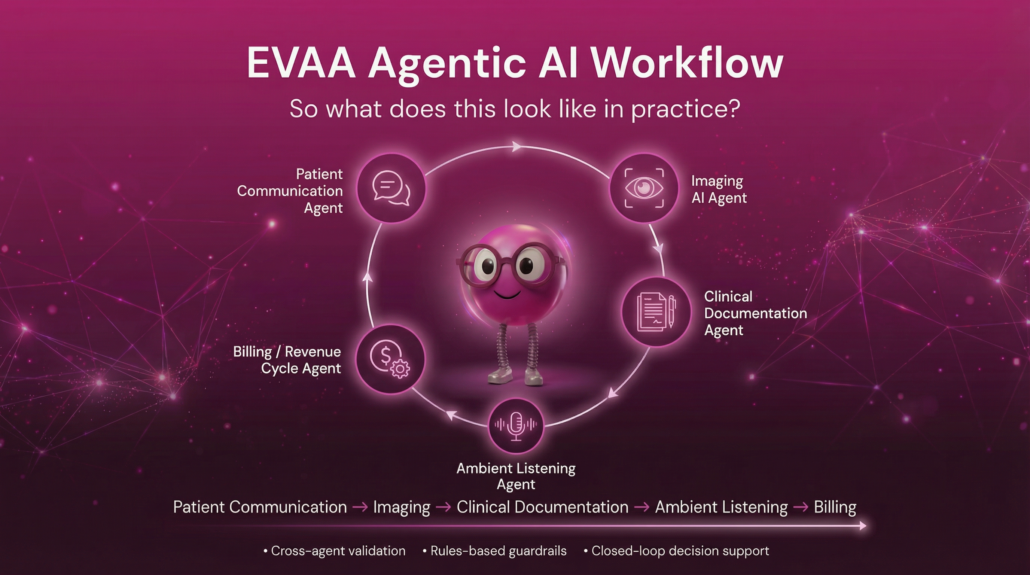
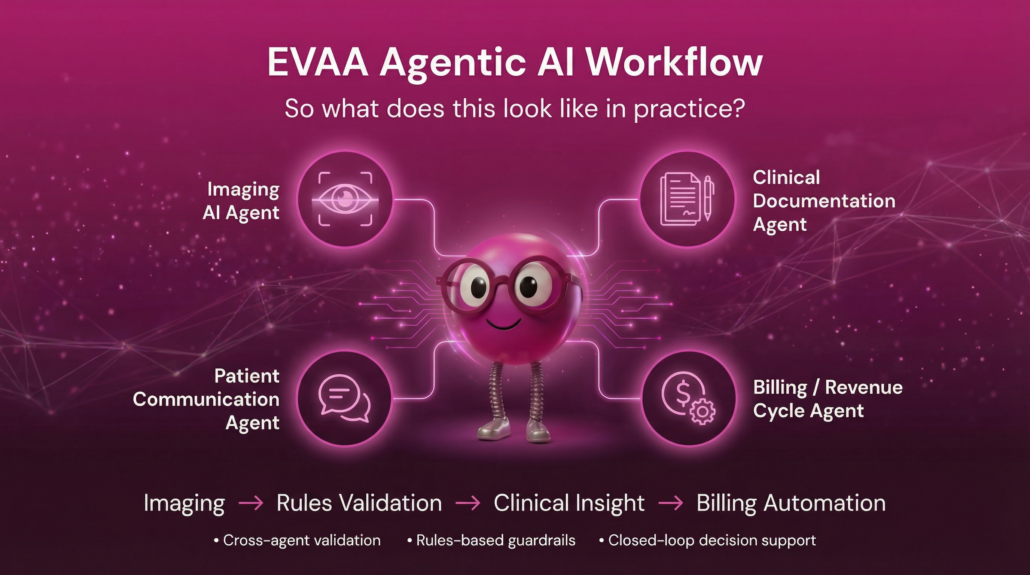
Rather than introducing another point solution, EVAA was presented as fundamentally different: an AI operating system designed to span the entire ophthalmology workflow.
From diagnostic imaging and clinical decision support to documentation and practice automation, EVAA connects and orchestrates the full continuum of care. It does not replace clinicians. It supports them by embedding intelligence directly into the workflow rather than layering it on top.
This shift from tools to systems is where the real value emerges.
Because in healthcare, the platform that owns the workflow ultimately becomes the system that drives outcomes.
Reducing Administrative Burden, Restoring Clinical Focus
➔ Watch AI in Ophthalmology: Inside a Standing-Room-Only ASCRS Session
A recurring theme throughout the session was the growing strain on physicians. Administrative tasks continue to consume valuable time, limiting the ability to focus on patient care.
EVAA addresses this challenge directly. By integrating capabilities such as ambient listening for documentation, structured clinical templates, and automated workflow coordination, the system reduces manual effort and increases consistency across the practice.
The result is not just operational efficiency. It is a return to what matters most in medicine.
More time for meaningful, face-to-face patient interactions.
A System That Learns: The Data Flywheel in Action
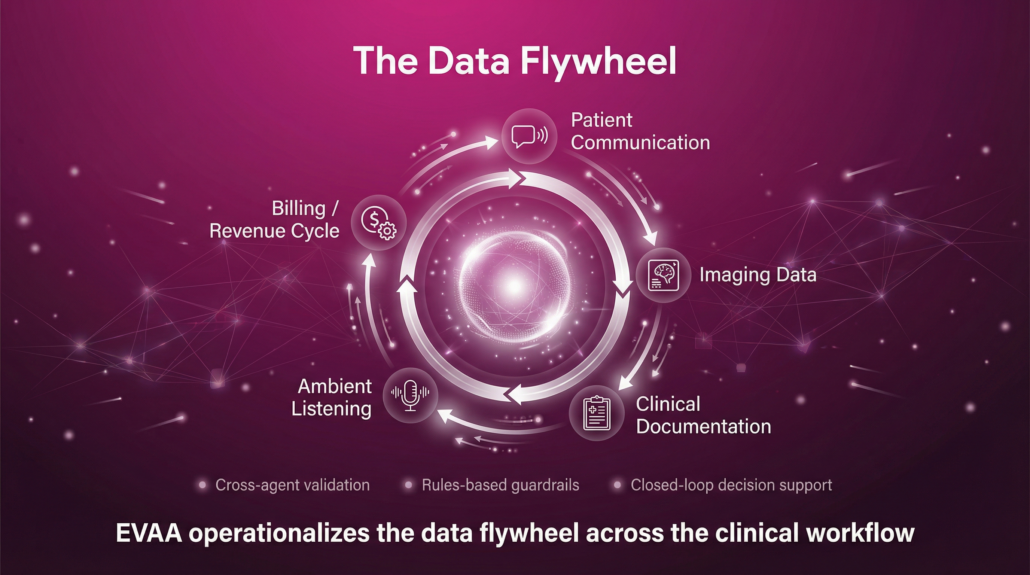
Central to EVAA’s architecture is the data flywheel concept.
Every patient interaction generates valuable data. Imaging results, clinical decisions, documentation, and outcomes all contribute to a continuous loop of learning. Unlike traditional systems, where data remains siloed, EVAA feeds this information back into the system, allowing it to improve over time.
This creates a compounding effect.
As the system is used, it becomes more accurate, more efficient, and more aligned with real-world clinical workflows.
It is not static AI. It is a continuously evolving intelligence.
Building Trust Through Guardrails and Clinical Protocols
In healthcare, trust is everything.
Rai addressed one of the most common concerns among physicians: whether AI can be relied upon in clinical decision-making.
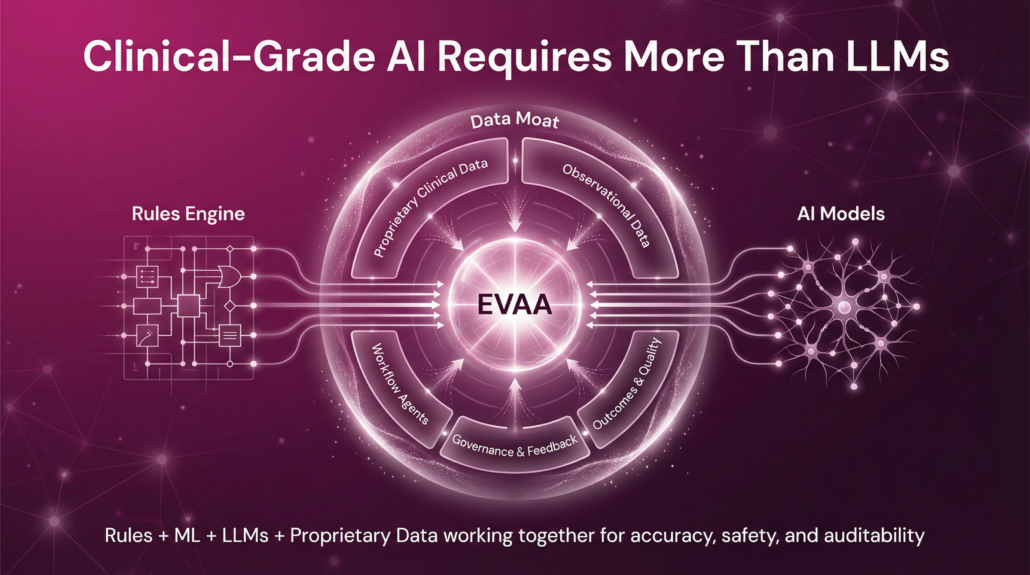
EVAA is built on a hybrid architecture that combines machine learning and large language models with a structured clinical rules engine. These built-in guardrails and protocols ensure that the system operates within established medical standards.
Rather than introducing uncertainty, this approach reinforces consistency and reliability. It allows AI to assist without overstepping its bounds, providing insights clinicians can trust.
Why Ophthalmology Is Leading the Way
Ophthalmology is uniquely positioned to benefit from AI.
The specialty is highly structured, imaging-driven, and repeatable. These characteristics create an ideal environment for AI to deliver measurable impact. From diagnostics to workflow optimization, the opportunity is not theoretical. It is immediate.
And as demonstrated at ASCRS, the eye care industry is beginning to recognize that the next phase of innovation will not come from isolated tools, but from integrated systems.
A Defining Shift in Healthcare AI
The success of Nitin Rai’s presentation reflects a broader shift taking place across healthcare. The conversation is moving beyond what AI can do. It is now focused on how AI fits into the reality of clinical practice.
EVAA represents that shift. A system designed not just to introduce intelligence, but to operationalize it across the entire workflow.
Because in the end, the goal is not automation for its own sake. It is better care.
And for physicians, that starts with something simple but increasingly rare: Time.
NOTE: This article was originally published in AI in Eye Care and is republished here with permission. Written by Selina Rai, Director of Marketing and Creative, First Insight Corporation.

