From Skepticism to Strategy: What Dr. Jay Henry Has Learned After a Year of Using AI in Practice
Artificial intelligence has become impossible to ignore in healthcare. Every conference agenda includes it. Every technology vendor talks about it. Every healthcare publication seems to have a prediction about how medicine will transform in the future.
Yet for many providers, the conversation still feels disconnected from reality.
Practice owners are not waking up each morning wondering how quickly they can implement artificial intelligence. They are thinking about staffing shortages, patient access, reimbursement challenges, administrative workload, and the growing pressure to do more with limited resources.
That was certainly the case for Dr. Jay Henry with Hermann and Henry Eyecare.
When Dr. Henry first began exploring AI-powered solutions for his practice, he wasn’t searching for the next big technology trend. He was searching for ways to solve everyday operational challenges that were consuming valuable time and energy.
More than a year later, after integrating AI into multiple areas of practice operations, his perspective has evolved considerably. While the broader healthcare industry continues to debate what AI might become, Dr. Henry has focused on a more practical question: What can it do today?
The answer, he says, has been both simpler and more impactful than many people expect.
“The biggest impact isn’t necessarily what happens in the exam room,” Dr. Henry explains. “It’s everything that happens around it.”
That observation highlights an important reality about modern healthcare. While clinical excellence remains at the center of every successful practice, much of the daily strain comes from the operational work that surrounds patient care. Phone calls, scheduling, insurance verification, claims processing, documentation, and countless other administrative responsibilities compete for the same finite resource: TIME.
For Dr. Henry, AI is less about automation and more about increasing capacity.
The Real Challenges Facing Independent Practices
Healthcare discussions often focus on clinical innovation, but the challenges that keep practice owners awake at night are frequently operational.
Recruiting and retaining qualified staff remain among the industry’s most persistent concerns. Administrative demands continue to increase. Insurance-related processes consume significant time and resources. Patients expect faster communication and more convenient access to care.
These challenges are rarely isolated.
A missed phone call becomes a voicemail that requires a callback. A delay in obtaining authorization creates additional follow-up work. Scheduling inefficiencies ripple throughout the day, affecting both patients and staff. Individually, these issues may seem manageable. Collectively, they create friction that impacts every aspect of a practice.
“Staffing is always a struggle,” Dr. Henry says. “Insurance authorizations and claims are always a struggle. Overall efficiency is always a struggle.”
What makes these pressures particularly difficult is that they often pull skilled professionals away from the work they were trained to do. Clinicians want to focus on patient care. Staff members want to help patients navigate their healthcare journey. Yet increasing amounts of time are spent managing processes rather than people.
This is where Dr. Henry believes technology can create meaningful value.
Not by replacing human expertise, but by reducing the administrative burden that prevents teams from operating at their full potential.
AI Doesn’t Replace People. It Removes Friction
One of the most common misconceptions surrounding AI is that its primary purpose is workforce reduction.
Dr. Henry’s experience suggests the opposite.
In his view, the most effective applications of AI are those that support staff rather than replace them. By handling repetitive, time-consuming tasks, technology allows employees to focus on activities that require communication, empathy, judgment, and problem-solving.
“When AI can pick up some of the workload, staff are happier,” he explains. “They stay longer, and you don’t have to hire as many people if AI is doing some of those background tasks.”
This distinction is particularly important in healthcare, where staffing shortages remain a significant challenge. Many practices are not looking for ways to eliminate positions. They are looking for ways to help existing teams operate more effectively without becoming overwhelmed.
The conversation around AI often focuses on productivity gains, but Dr. Henry believes the more meaningful outcome is sustainability.
When staff members spend less time on repetitive administrative work, they have more capacity to engage with patients. When providers spend less time managing workflow bottlenecks, they can focus more fully on clinical care. When operational burdens are reduced, the entire organization benefits.
In that sense, AI becomes less of a technology initiative and more of a workforce support strategy.
The Most Important Lesson Had Nothing to Do With Technology
Perhaps the most valuable lesson Dr. Henry has learned over the past year has little to do with artificial intelligence itself.
It has to do with people.
When asked about implementation challenges, he does not point to software limitations or technical failures. Instead, he points to the way organizations introduce change.
“The technology never really failed,” he says. “We failed in the aspect of not bringing our staff in early enough in the process.”
Many healthcare leaders will recognize this insight.
Organizations often evaluate technology behind closed doors, make a decision, and then present employees with a completed plan. While efficient from a management perspective, this approach can create uncertainty among the very people expected to use the new system.
Employees naturally ask questions:
- Why are we changing?
- How will this affect my role?
- Will this create more work?
- Is this replacing part of what I do?
Without clear communication, those questions can quickly turn into resistance.
Dr. Henry and his team learned that successful implementation requires staff involvement from the beginning. Rather than simply announcing a new solution, they explain the problems they are trying to solve. They discuss why the technology is being evaluated and how it will impact daily workflows. Most importantly, they create opportunities for employees to ask questions and voice concerns.
That approach has transformed adoption.
“When they realize it’s not taking their job, it’s there to help them and make their jobs easier, they’re much more inclined to be involved with it.”
The lesson extends far beyond AI. Successful technology adoption is ultimately a leadership challenge, not a software challenge.
Building Trust as AI Transforms Healthcare
Even among practitioners who recognize the potential value of AI, trust remains one of the biggest barriers to adoption.
Healthcare is not an industry where mistakes are easily tolerated. Accuracy matters. Context matters. Clinical judgment matters.
And AI, despite its capabilities, is not perfect. Like any technology, it can produce errors. It can misinterpret information. It can miss important nuances.
For many providers, these limitations create understandable hesitation.
Dr. Henry acknowledges those concerns, but he believes they stem from a misunderstanding of AI’s role within healthcare.
The technology should not be viewed as a replacement for clinical decision-making. It should be viewed as an enhancement to clinical decision-making.
“The doctor should be the ultimate decision-maker,” he says. “AI should be helping us, giving us information, but not making the final decisions.”
This perspective offers a practical framework for adoption. Rather than asking whether AI can replace a clinician’s expertise, practices should ask how AI can help clinicians make better-informed decisions.
When positioned correctly, AI becomes a tool that supports professional judgment rather than competes with it.
The Next Frontier: AI as a Clinical Partner
While much of today’s AI activity is focused on administrative efficiency, Dr. Henry believes the next wave of innovation will be increasingly clinical.
Not because AI will replace providers, but because it can help them process information more effectively.
Modern technology-heavy eyecare generates enormous amounts of data. Imaging studies, visual fields, diagnostic testing, and longitudinal patient records all contribute valuable insights. The challenge is not collecting information. The challenge is identifying meaningful patterns within it.
This is where Dr. Henry sees tremendous opportunity.
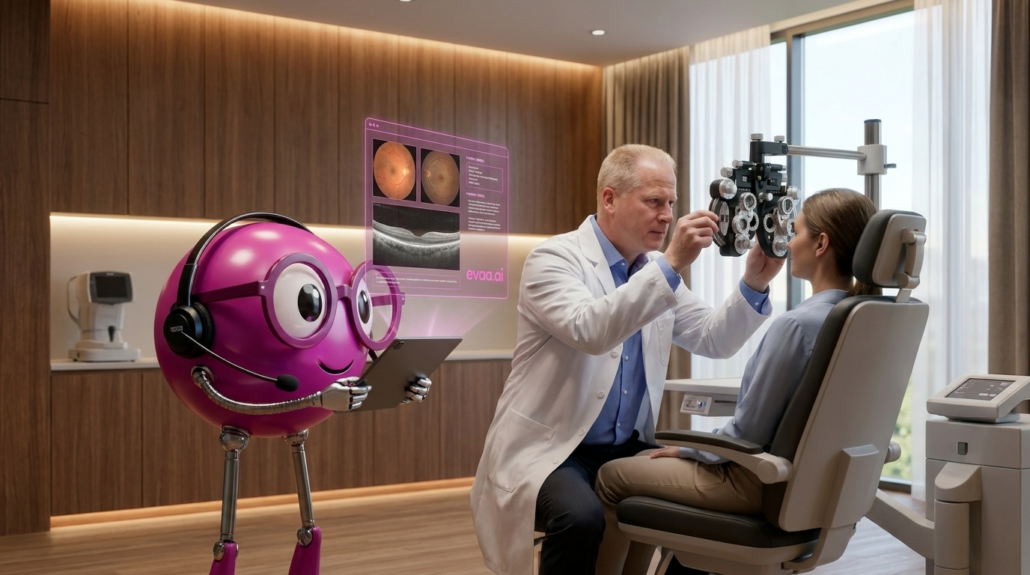
He envisions AI functioning as a second set of eyes, continuously analyzing data and highlighting trends that deserve closer attention.
A subtle change in a visual field. A gradual progression in imaging results. A pattern that may not be immediately obvious during a busy clinic day.
These are the types of insights AI may eventually help surface.
“It’s going to help us manage disease processes better and help us make better clinical decisions,” he says.
Importantly, the technology is not making the diagnosis.
The clinician still evaluates the information, applies clinical judgment, and determines the appropriate course of action.
What changes is the quality and accessibility of information available to support that decision.
Preparing the Next Generation of Clinicians
As AI becomes increasingly integrated into healthcare, another question is emerging.
How will it affect education?
If technology becomes more capable of identifying abnormalities, analyzing images, and recognizing patterns, what happens to the traditional skills future clinicians are expected to develop?
The question remains largely unanswered, but it represents one of the most important conversations facing healthcare educators.
Dr. Henry compares the situation to calculators.
The introduction of calculators changed how mathematics is performed, but it did not eliminate the need to understand mathematical principles. Students still learn the fundamentals because those concepts provide the foundation for higher-level thinking.
The same principle applies to healthcare.
Future clinicians must continue learning how to evaluate images, interpret data, and make independent clinical decisions. AI may become an increasingly valuable tool, but expertise remains essential.
Technology can assist. It cannot replace professional responsibility.
As educational institutions begin exploring how AI will influence training programs, maintaining that balance will be critical.
Looking Beyond the Hype
The healthcare industry is still in the early stages of understanding AI’s long-term impact. Predictions about the future range from revolutionary to unrealistic, making it difficult for practice owners to separate meaningful opportunities from marketing promises.
Dr. Henry’s experience offers a useful reminder.
The most successful organizations are unlikely to be the ones chasing every new technology trend. They will be the ones who identify genuine problems, evaluate solutions thoughtfully, involve their teams in the process, and remain focused on outcomes rather than hype.
After more than a year of working with AI, he does not describe it as a magic solution. Instead, he describes it as a tool.
A powerful tool, certainly, but still one that requires leadership, strategy, and human oversight.
Perhaps that is why his perspective feels particularly relevant.
The future of eye care is not about replacing clinicians, staff members, or human connection. It is about creating systems that allow healthcare professionals to spend more time doing what only they can do.
For Dr. Henry, that is the true promise of AI.
Not that AI can replace the human element of care.
But AI can create more space for it.
Every Practice Has Opportunities. The challenge is knowing which ones matter most.
