Signs Your EHR Isn’t Keeping Up With Your Practice
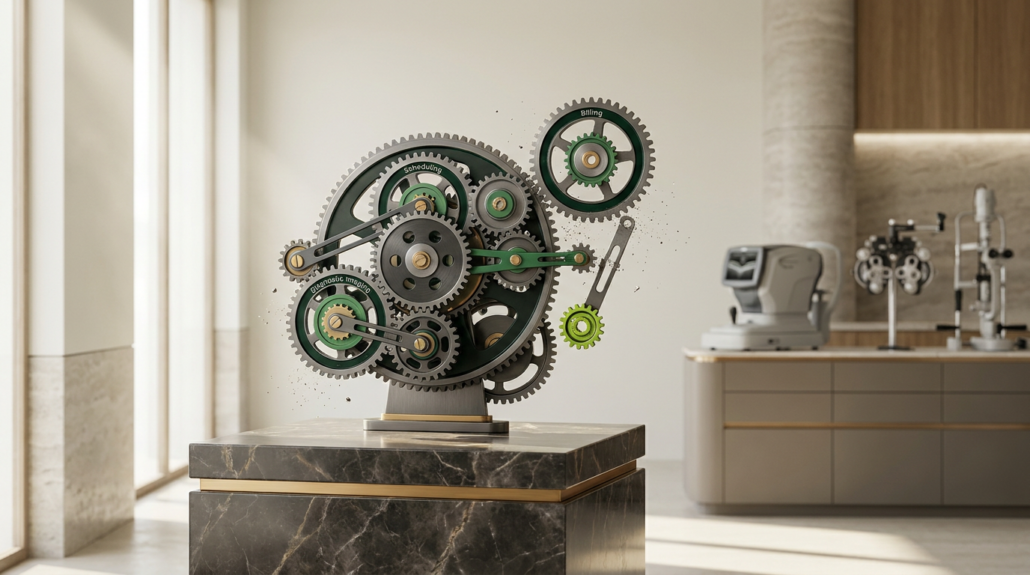
An EHR that handles scheduling, documentation, billing, and patient records still falls behind as practice needs evolve. Warning signs emerge in daily workflows: staff rely on workarounds, providers spend more time documenting, data moves manually between systems, and reporting requires extra effort.
For eye care practices reviewing their technology, these signs can help identify whether the EHR still fits the way the practice operates.
1. Staff Rely on Workarounds to Complete Routine Tasks
Spreadsheets, handwritten notes, separate trackers, and repeated data entry often signal workflow gaps. When workarounds become routine, practices should examine why staff manage information outside the EHR. This helps identify inefficiencies in scheduling, patient communication, billing, and reporting.
2. Providers Spend Too Much Time Documenting
Eye care documentation involves recording visual acuity, intraocular pressure, refraction, clinical findings, imaging results, and treatment plans. When this process requires excessive navigation, repetitive data entry, or after-hours charting, it adds to the provider’s workload. Customizable EHR templates and AI-assisted documentation help reduce these inefficiencies while allowing providers to review and finalize clinical records.
3. Diagnostic Information Does Not Move Easily Into the Chart
Eye care practices rely on data from diagnostic devices such as OCTs, fundus cameras, visual field devices, autorefractors, and lensmeters. Manually transferring or retrieving results adds unnecessary steps to daily workflows. EHR integrations help streamline data exchange and make diagnostic information accessible during patient care.
4. Administrative Work Keeps Growing
As patient volume grows, so does the administrative workload across scheduling, recalls, eligibility verification, intake, billing, and follow-up. When manual effort increases at the same rate, existing technology needs closer evaluation. Automating routine, rules-based tasks helps practices manage higher volumes while allowing staff to focus on exceptions and patient needs.
5. Information Has to Be Reentered Between Workflows
Patient care and revenue cycle workflows depend on accurate information moving between departments. Disconnected systems create repetitive data entry and manual coordination that increase workload and error risks. An integrated EHR and practice management system helps streamline these processes and improve information flow.
6. Reporting Requires Too Much Manual Work
Practice leaders need timely data to assess performance and identify trends. When basic reporting requires multiple exports or manual data consolidation, it adds unnecessary administrative work. As practices expand, integrated reporting helps leaders monitor performance across providers and locations more efficiently.
7. Every New Provider or Location Adds Technology Friction
As practices grow, new providers and locations introduce additional workflow and integration requirements. The EHR should adapt to these changes without creating more manual work. Frequent workarounds and disconnected applications signal that the system is struggling to support expansion.
Look at the Work Around Your EHR
An EHR’s limitations often become apparent through the extra work required to keep daily operations running. Repetitive tasks, lost provider time, disconnected workflows, and growing operational complexity signal the need to reassess whether the system still meets the practice’s needs.
If your practice is evaluating whether its current system can support what comes next, schedule a MaximEyes demo to explore a connected EHR and practice management platform built for eye care.
