AI in Ophthalmology and Optometry: A Practical Guide to Artificial Intelligence in Eye Care

Artificial intelligence (AI) is reshaping modern eye care from the exam room to the front desk, and AI in eye care is quickly becoming a critical tool for practices. Optometrists and ophthalmologists are using AI to detect diseases earlier, reduce administrative burden, and improve both clinical and operational workflows.
This transformation is happening at a critical time. More than 2.2 billion people worldwide experience vision impairment, yet many regions still struggle with shortages of eye care professionals. In some areas, the optometrist-to-patient ratio remains far below the recommended 1 provider per 50,000 patients.
AI is helping address these challenges through advanced diagnostic tools and workflow automation across ophthalmology and optometry practices. AI-powered screening systems can detect conditions such as diabetic retinopathy and glaucoma with high accuracy.
At the same time, practice management software used in ophthalmology and optometry practices, along with AI assistants such as EVAA.ai, are helping automate scheduling, documentation, and patient communication.
This guide breaks down how these technologies work, where they deliver the most value, and how to implement them effectively in your practice.
What is AI in Ophthalmology and Optometry
AI in ophthalmology and optometry refers to software systems that analyze medical data, automate routine administrative tasks, and assist clinicians with diagnostic decision-making.
AI technologies in eye care can assist with:
- retinal disease detection
- medical image analysis
- appointment scheduling
- clinical documentation
- billing and insurance workflows
- patient communication
These technologies do not replace clinicians. Instead, they serve as decision-support and workflow-optimization tools that help practices deliver care more efficiently.
Understanding AI Applications in Clinical Ophthalmology and Optometry Practice

AI-powered retinal screening systems can detect conditions such as diabetic retinopathy and macular edema in seconds.
AI-Powered Screening and Detection Tools
Clinical screening has become more accessible through autonomous AI systems that analyze retinal images without requiring specialist oversight.
The FDA has cleared several devices for diabetic retinopathy detection, including:
- LumineticsCore®
- EyeArt®
- AEYE-DS
These systems identify retinal indicators such as microaneurysms and macular edema, delivering diagnostic results in under 60 seconds.
Research shows that AEYE-DS demonstrated diagnostic sensitivity between 92% and 93% and specificity between 89% and 94% in large clinical studies. More than 99 percent of patients received diagnostic results using only a single retinal image per eye.
EyeArt has also shown strong performance, achieving over 96% sensitivity in detecting more-than-mild diabetic retinopathy.
AI algorithms used for glaucoma screening have achieved accuracy rates between 89.7 % and 94.3% when analyzing fundus images.
Diagnostic Support for Common Eye Conditions
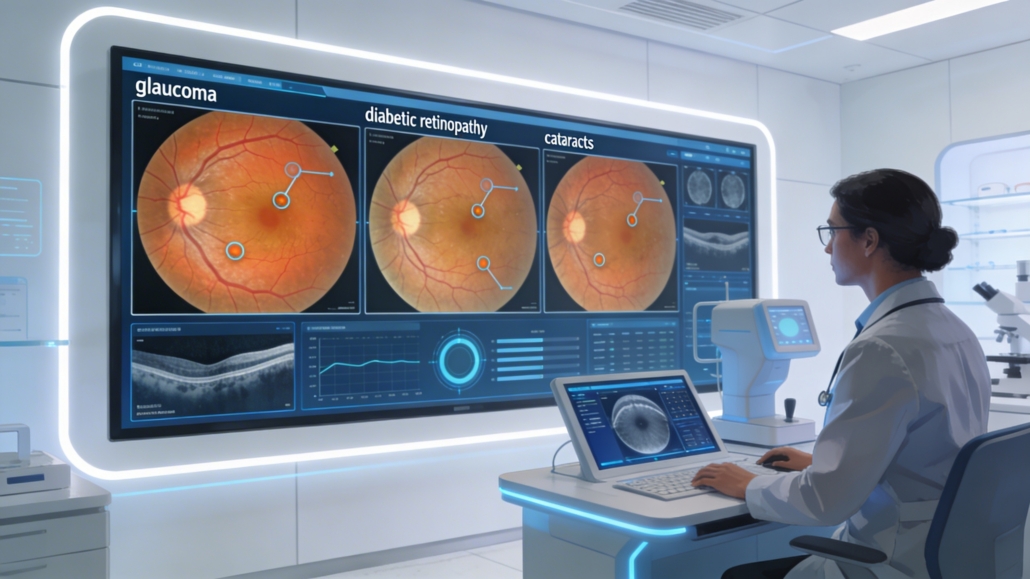
AI diagnostic tools help eye care professionals analyze retinal scans and identify conditions such as glaucoma, diabetic retinopathy, and cataracts.
AI systems are expanding beyond diabetic retinopathy to detect multiple retinal and corneal conditions.
Deep learning models that combine neural network architectures have achieved 98.2% accuracy in classifying diabetic retinopathy, cataracts, and glaucoma.
AI systems analyzing optical coherence tomography scans have achieved 91% accuracy in identifying intraretinal and subretinal fluid associated with age-related macular degeneration.
Corneal disease detection also benefits from AI analysis of topography maps. Some models demonstrate 99.3% accuracy in detecting keratoconus-related corneal thinning and bulging.
Another emerging field known as oculomics uses retinal imaging to identify early indicators of systemic diseases, including:
- cardiovascular disease
- chronic kidney disease
- neurodegenerative disorders
Treatment Planning and Patient Monitoring
Beyond diagnosis, AI models can analyze historical patient data to predict disease progression, enabling earlier, more targeted interventions.
Machine learning systems evaluating OCT scans, visual field tests, and intraocular pressure measurements have demonstrated a strong ability to forecast glaucoma progression. Research shows that AI can predict rapid visual field worsening with an AUC of 0.87 using early OCT data.
Remote monitoring platforms are also emerging. Systems such as Remoni Health combine digital patient tests with AI analytics to monitor chronic eye diseases, including glaucoma, AMD, and diabetic retinopathy. These systems have already processed more than 120,000 patient encounters.
Integration With Existing Ophthalmology and Optometry Equipment

AI assistants can help analyze imaging data, support clinicians, and streamline workflows during eye exams.
AI technologies are designed to integrate with existing ophthalmology and optometry diagnostic tools. AI assistants for healthcare practices, such as EVAA.ai, help ophthalmology and optometry practice management by optimizing workflows among clinical diagnostic tools.
Smartphone-based fundus cameras equipped with integrated AI can generate vertical cup-to-disk ratio reports in under 10 seconds and function offline in areas without internet connectivity.
These portable systems produce retinal images comparable to those from traditional imaging equipment and enable instant digital transfer for teleconsultation.
As AI integrates deeper into clinical equipment, AI-powered practice assistants such as EVAA.ai are also taking on operational work, from scheduling and patient communication to documentation and billing.
Watch the video below to see how AI assistant technology supports workflow automation in eye care practices.
How AI Improves Ophthalmology and Optometry Practice Management and Workflow Automation
Automated Appointment Scheduling and Patient Triage
AI scheduling systems allow patients to book appointments 24 hours a day, capturing nearly 40% of patients who prefer scheduling after business hours.
Traditional front desk operations miss 34-42% of incoming calls, resulting in significant loss of appointments and revenue.
AI reception systems can handle unlimited simultaneous calls while improving appointment capture rates. In addition, automated reminders delivered via text messages or email have also been shown to reduce no-show rates by up to 38%.
Electronic Health Record Optimization
Documentation remains one of the most time-consuming tasks for clinicians, and one of the most fertile areas for AI-driven efficiency gains. AI transcription systems have been deployed across more than 2.5 million patient visits, saving nearly 15,800 hours of documentation time.
Practice management software for optometry and ophthalmology practices with AI capabilities can reduce daily charting time by approximately 2 hours per clinician. Many providers report that AI-assisted documentation allows them to maintain stronger patient engagement during appointments.
Billing and Insurance Claim Processing
Manual billing processes often lead to coding errors and incomplete submissions. These inefficiencies can result in claim denial rates of up to 23 percent.
Automated billing systems that incorporate AI validation can reduce these errors and achieve claim acceptance rates exceeding 98 percent.
Inventory Management for Contact Lenses and Eyewear
AI tools can analyze patient demographics and purchasing patterns to optimize inventory decisions. Practices can receive recommendations for stock eyewear and contact lens products that match patient demand patterns. This helps reduce excess inventory while improving product availability.
Examples of AI Tools Supporting Eye Care Practices
Several categories of AI technologies are currently being adopted across eye care practices:
- AI retinal screening systems
- OCT image analysis tools
- AI documentation assistants
- Automated patient communication platforms
- Workflow optimization software
Solutions such as EVAA.ai demonstrate how AI assistants can help practices manage operational workflows and improve efficiency.
Implementing AI Technology in Your Ophthalmology or Optometry Practice
Assess Practice Needs
Before adopting any AI tools, practices should map their biggest operational challenges, whether that is scheduling gaps, billing errors, or documentation overload. Starting with a clear problem makes it easier to evaluate solutions.
Choose the Right AI Platforms
Prioritize systems that integrate with existing technology, have appropriate regulatory clearance, and provide reliable support.
Train Staff and Encourage Adoption
Successful AI implementation depends on staff buy-in. Involve your team early, provide hands-on training, and designate a champion to support adoption. Introducing one technology at a time allows teams to adapt more effectively.
Evaluate Return on Investment
Track metrics like no-show rates, documentation time, and patient throughput. Many practices report measurable improvements within the first few months of adoption.
Challenges and Limitations of AI in Eye Care
Data Privacy and Security
AI systems must comply with healthcare regulations such as HIPAA. Clinics should ensure vendors provide strong encryption and access controls.
Need for Human Oversight
AI systems are decision-support tools. Final clinical judgment must always rest with the provider, particularly for diagnosis and treatment planning.
Regulatory Requirements
Clinical AI tools used for diagnosis or screening typically require FDA clearance before deployment. Practices should verify the regulatory status of any tool before clinical use.
Addressing Algorithm Bias
AI models trained on narrow datasets may underperform for certain patient populations. When evaluating tools, ask vendors about the diversity of their training data and how performance is validated across demographics.
Bringing It All Together
Artificial intelligence is reshaping modern eye care from the exam room to the front desk, and AI in ophthalmology and optometry is quickly becoming a critical tool for modern practices.
From autonomous retinal screening tools to workflow automation platforms such as EVAA.ai, AI technologies are helping practices improve efficiency while maintaining high-quality patient care.
Practices that adopt these technologies thoughtfully will be well-positioned to deliver better care and run more efficient operations. This starts with setting clear goals, investing in staff training, and monitoring outcomes.
Frequently Asked Questions About AI in Eye Care
How accurate are AI systems in detecting eye diseases?
AI systems demonstrate strong accuracy when detecting conditions such as diabetic retinopathy and glaucoma. FDA-cleared tools like AEYE-DS have shown diagnostic sensitivity ranging from 92% to 93%.
What are the cost benefits of AI in ophthalmology and optometry practices?
AI reduces administrative workload, improves billing accuracy, decreases claim denials, and frees clinician time for patient care.
Can AI work with existing ophthalmology and optometry equipment?
Yes. Many AI tools integrate with fundus cameras, OCT scanners, and practice management software used in optometry and ophthalmology practices.
What privacy concerns exist with AI systems?
AI vendors must comply with healthcare data protection regulations, including HIPAA, and implement strong encryption and access controls.
How long does it take staff to adopt AI systems?
Adoption timelines vary, but most practices reach full operational comfort within a few weeks of consistent use. Introducing one tool at a time significantly reduces friction.
Ready to see how AI can improve your eye care practice?
EVAA.AI helps eye care teams automate workflows, improve patient and staff communication, and simplify daily operations. Clinicians can spend more time on patient care and less on administrative tasks, ultimately increasing revenue.
👉 Explore EVAA and see how AI can support your practice.
Sources
- World Health Organization. World Report on Vision. https://www.who.int/publications/i/item/9789241516570
- U.S. Food and Drug Administration. FDA permits marketing of artificial intelligence-based device to detect diabetic retinopathy. https://www.fda.gov/news-events/press-announcements/fda-permits-marketing-artificial-intelligence-based-device-detect-certain-diabetes-related-eye
- Abràmoff MD et al. Autonomous artificial intelligence-based diagnostic system for detection of diabetic retinopathy. NPJ Digital Medicine. https://www.nature.com/articles/s41746-020-00368-7
- Autonomous Artificial Intelligence for Diabetic Retinopathy Screening. JAMA Network Open. https://jamanetwork.com/journals/jamanetworkopen/fullarticle/2786132
- Development and validation of a deep learning system for detection of glaucoma from fundus photographs. Nature Medicine. https://www.nature.com/articles/s41591-018-0107-6
- Ting DS et al. Artificial Intelligence and Deep Learning in Ophthalmology. British Journal of Ophthalmology. https://bjo.bmj.com/content/103/2/167
- De Fauw J et al. Clinically applicable deep learning for diagnosis and referral in retinal disease. Nature Medicine. https://www.nature.com/articles/s41591-018-0107-6
- Kuo CF et al. Artificial intelligence in keratoconus detection. Scientific Reports. https://www.nature.com/articles/s41598-020-65286-5
- Parikh A et al. Effect of text message reminders on patient appointment attendance. JAMA Network Open. https://jamanetwork.com/journals/jamanetworkopen/fullarticle/2753520
- American Medical Association. Augmented intelligence in health care. https://www.ama-assn.org/practice-management/digital/augmented-intelligence-health-care
- Change Healthcare. Revenue Cycle Denials Index. https://www.changehealthcare.com/insights/revenue-cycle-denials-index
- Healthcare Financial Management Association. Revenue Cycle Management resources. https://www.hfma.org/topics/revenue-cycle.html
- Abràmoff MD, Lavin PT, Birch M, Shah N, Folk JC. Pivotal trial of an autonomous AI-based diagnostic system for the detection of diabetic retinopathy in primary care offices. NPJ Digital Medicine. https://www.nature.com/articles/s41746-018-0040-6